You're in edit mode. Click any dashed text block to edit it — changes save automatically when you click away.
Official Announcements
Click the images below to read the latest official letters and announcements from the Diocese.
Bishop's Corner
"Grace to you and peace from God our Father and the Lord Jesus Christ. As we navigate the changing seasons of our church life, let us remain steadfast in our mission to equip the saints for the work of ministry."
- Bp. Richard Stone B. Banagui
Brief History
The story of the Episcopal Diocese of North Central Philippines sits within a longer institutional lineage. What is now the Episcopal Church in the Philippines began in 1901 as a single Missionary District under The Episcopal Church in the United States. That mission was divided into three missionary districts in 1973, one of which became the Diocese of Central Philippines in 1985.
On July 7, 1988, the House of Bishops voted to divide the Diocese of Central Philippines further, creating the Diocese of North Central Philippines. The new diocese held its first Annual Convention in February 1989, electing the Rev. Dr. Artemio M. Zabala as its first bishop. Just over a year later, on May 1, 1990, the Philippine Episcopal Church itself became autonomous, taking its place as the 28th Province of the Anglican Communion — so the Diocese was born in the same season that gave the wider Philippine church its own independence. The Diocese consists of Episcopal Congregations in Baguio City, the provinces of Benguet, La Union, Pangasinan, Tarlac, Southern Nueva Vizcaya and Zambales.
The Diocese's early years were tested almost immediately. On July 16, 1990, a magnitude 7.7 earthquake struck Baguio City, destroying the Diocesan Cathedral along with much of the city. Plans for rebuilding began at once. In the aftermath, the diocese also deployed personnel to Lawin, Zambales for relief and rehabilitation work, an effort that in time grew into a new congregation formed among the local community there.
In 1992, Bishop Zabala resigned his jurisdiction to serve as the Episcopal Church in the Philippines' missionary to the Diocese of Los Angeles. The Convention of January 1993 elected the Rt. Rev. Joel A. Pachao as the Diocese's second bishop, who continued the rebuilding effort. In 2000, the New Cathedral — the Cathedral of the Resurrection — was consecrated for use, a decade after the earthquake that destroyed its predecessor.
The Cathedral
The Diocesan Cathedral is the Cathedral of the Resurrection located at 358 Magsaysay Avenue, Baguio City.
Vision & Mission
Vision
By the year 2007 we envision a God-fearing diocese with dynamic human resources and vibrant members, self-reliant and aggressively reaching out.
Mission
The Mission of the Diocese is to equip both clergy and lay with arms and instruments that are effective in the ministry through continuous and responsive education and training.
Of the Seal of the Diocese
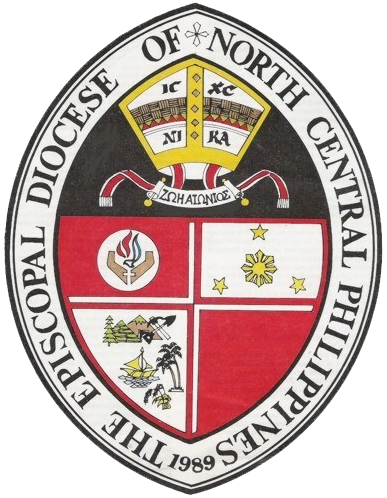
At the topmost portion of the inner versica is the Miter which graces most Episcopal Church seals. It stands for the authority of the Bishop (in Greek being Episcopos, from which the designation Episcopal is derived). The miter bears on its top the Greek letters ICXC, the ancient acronym for IESOUS CHRISTOS or Jesus Christ. Below is the Greek word NIKA which means Victor or Conqueror. Put together it proclaims Jesus Christ the Conqueror (of sin and death). The miter is adorned with a design representing the motif of most art works of the indigenous people of Benguet against a backdrop of dominant brown color, the color of the Filipino skin. The context where Christ is proclaimed as Conqueror in the diocese is among the indigenous and other Filipino people residing in the provinces within the jurisdiction.
An unfurled scroll below the miter bears the words ZOE AIONIOS, “life eternal” which Christ promised to give to the full (John 10:10). The words were retained in Greek to amply describe the divine quality of life shared by God in Jesus' death and resurrection. This message of abundant life given by Jesus is also at the heart of the National Mission Statement. That abundant life includes autonomy, the spaciousness in which we grow to be ourselves in relation to others in mutual responsibility and interdependence.
Below the scroll is the shield that resembles that which is found in the seal of the Diocese of Central Philippines. This indicates that this diocese once formed part of that diocese until its creation as a separate diocese in 1989. The shield is divided into four panels. The right topside panel bears the sun and stars found in the Filipino flag and is in the seal of the Church Province. This situates us along with the lower left panel with the images of the highlands and lowlands, the miner's pick and shovel, rice grains and sea with a boat.
The top left panel bears the symbol that graced the ECP's inauguration as a Church Province. It becomes a constant focus of meditation and judgement as it artistically delivers the message; “Kapit-bisig kay Kristo: tungo sa Kasarinlan, Katarungan at Kapayapaan” (Arm-in-arm in Christ towards Autonomy, Justice and Peace).
That inauguration symbol rewards a closer look. Its brown figures form both a church spire and two arms holding a cross at once, a visual pairing of communion and shared purpose. In Filipino culture, kapit-bisig (arm-in-arm) is more than a gentle gesture — it is the image of a community standing shoulder to shoulder in collective strength, the same posture taken by ordinary people defending their homes, or by indigenous communities standing together for their ancestral land. The dove worked into the design, painted by artist Taklin Reyes, reveals on closer inspection the outline of a sword, a reminder that peace and justice are never separate from cost. The seal's red stands for the blood of martyrs and of Christ himself, while its brown honors the land and the sacrifices of those who came before. Together, the images ask the Diocese to hold two things at once: the comfort of communion, and the cost of standing for what is right.
Adapted from the writings of the Rt. Rev. Artemio M. Zabala, the Diocese's first bishop.
The Bishop

The Rt. Rev. Richard Stone B. Banagui
Diocesan Bishop358 Magsaysay Avenue, Baguio City
P.O. Box 403, Baguio City, Philippines
Telephone: (074) 442-2432
Diocesan Map
Explore congregations, missions, and stations across the Diocese. Click any pin for details.
Congregations (Parishes)
Click on a Deanery below to view the full and aided parishes.